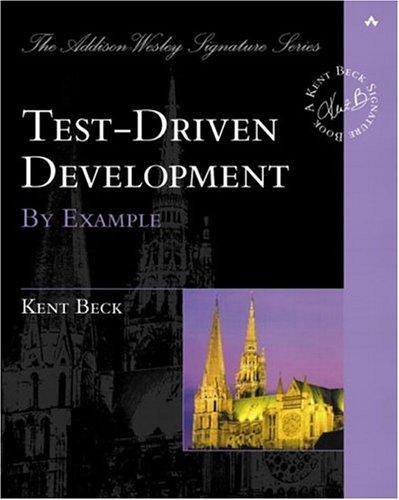
The founding TDD text by Kent Beck: test first, code second, fear gone.
Why this book
Everyone talks about TDD and almost nobody knows where it comes from. It comes from here. In 2002, Kent Beck, the inventor of Extreme Programming and co-author of JUnit, set the discipline down in one short, strange book: he doesn't explain TDD to you, he codes in front of you, line by line, showing every mistake and every step back. You read over his shoulder.
Most testing books hand you a list of best practices. Beck instead shows the method as it actually happens, on two real cases: first a small class that handles money in several currencies, then a testing framework he grows by using it to test itself. Beneath the mechanics of testing, he plants an idea nearly all his imitators forgot: programming is, above all, about managing your fear of breaking the code. That idea, far more than the red-green-refactor cycle, is why the book still holds up twenty years later.
The ideas that stick
The book runs 240 pages across three parts. Here is what stays with you once it's closed.
1The red, green, refactor cycle
The whole method fits in three beats repeated endlessly:
- Red: write a failing test;
- Green: make it pass as fast as you can, by any means, even ugly;
- Refactor: clean the code without breaking anything.
// 1. RED: write the test BEFORE the code
test('5 + 3 = 8', () => expect(sum(5, 3)).toBe(8))  // ✗ sum doesn't exist

// 2. GREEN: the dumbest code that passes, even hard-coded
function sum(a, b) { return 8 }                       // ✓ shameful, but green

// 3. REFACTOR: a 2nd test breaks the hard-coded "8", you generalize
function sum(a, b) { return a + b }                   // ✓ clean, still green
The line that stings: during step two, anything goes to get green (even a hard-coded return 8), but only long enough to get there. Beck puts it this way: "quick green excuses all sins. But only for a moment." You never refactor on red, and you never leave duplication behind. Ron Jeffries' phrase sums up the book's goal in four words: clean code that works.
2Writing the test first is design
The test doesn't come after the code, it comes before the class itself. Beck starts by writing what he'd like to be able to type, as if telling the perfect usage story from the outside: "when we write a test, we imagine the perfect interface for our operation." His very first test creates a Dollar object that doesn't exist yet:
public void testMultiplication() {
    Dollar five = new Dollar(5);
    five.times(2);
    assertEquals(10, five.amount);
}
This test doesn't even compile: four errors (no Dollar class, no constructor, no times method, no amount field). Beck fixes them one by one. The compile error isn't a failure, it's the normal first step. The test designed the API before a single line of logic existed.
3"Fake it": cheat to get started
The most counterintuitive technique in the book. To go green as fast as possible, return a hard-coded constant. The test wants 10? Write return 10. Green bar. Then, and this is the genius, make the cheat visible: 10 is 5 times 2, so write amount = 5 * 2. Now the duplication jumps out: the 5 and the 2 live in both the test and the code.
To remove it, you replace constants with variables, step by step, until amount = amount * multiplier. It's removing that duplication between test and code that forces generalization, not an abstract decision made in your head. You don't think up the general code: you get it by deleting the copy.
4Triangulate: generalize from two examples
When you can't see at all how to generalize, add a second test that makes the cheat impossible. To test that two Dollars are equal, a single test (5 equals 5) is happy with return true. Add "5 does not equal 6", and the constant collapses: you're forced to actually compare the amounts. Beck calls this triangulation: "only abstract when you have two or more examples." But he's honest about his own use: "I only use triangulation when I'm really, really unsure about the correct abstraction." It's not the default tool, it's the safety net when you're lost.
5The to-do list as a steering wheel
Before writing the first test, Beck lists everything that will need testing. The current item is bold, the finished one is crossed out. When an idea pops up mid-cycle (an edge case, a refactoring to do), he doesn't handle it right away: he adds it to the list and stays focused on the task at hand.
The list is his working memory laid out on the table: it keeps the focus on one thing at a time, and it tells him when he's done, when it's empty. TDD, he says, is a steering process: a little to the left, a little to the right, never one big plan frozen in advance.
6TDD is about managing fear
This is the book's real thesis, the one its imitators forgot. "Test-driven development is a way of managing fear during programming." Stress creates a vicious circle: the more afraid you are of breaking things, the less you test, the more bugs you introduce, the more afraid you get. TDD breaks the loop.
Beck says it plainly: "the more stress I feel, the more I run the tests." The green bar isn't just a light: it's a dose of calm. His most beautiful phrase: tests are the programmer's stone, they transmute fear into boredom. Not the boredom of being stuck, the quiet boredom of someone who knows nothing is going to blow up.

7xUnit: the tree every modern test runner grows from
Part two is dizzying: Beck builds a testing framework by using it to test itself. At the very start the framework doesn't exist, so he checks by hand, then, as soon as the TestCase class stands up, he has it test its own execution. Out of that bootstrap come the bricks you know without knowing it:
setUpandtearDown: every test starts from a clean, independent state;- TestSuite: groups tests and is handled like a single one;
- TestResult: counts passes and failures.
Martin Fowler summed it up: never in the annals of software engineering was so much owed by so many to so few lines of code. JUnit, pytest, Jest, PHPUnit: they all descend from this handful of classes.
8The limits, stated by the author himself
What makes the book credible is that its author refuses to oversell. Beck raises the awkward questions himself in the final chapter:
- Is TDD proven? "No. No studies have categorically demonstrated the difference between TDD and any of the many alternatives in quality, productivity, or fun."
- Legacy code? "The biggest problem is that code that isn't written with tests in mind typically isn't very testable."
- Step size? No single answer: you must be able to take small steps AND big ones, and choose by your confidence of the moment.
And he puts it all in perspective: "good engineering is maybe 20% of a project's success." It's the opposite of a guru.
Three things I didn't know
- The famous multi-currency money example isn't Beck's. He rebuilds the object that Ward Cunningham, the inventor of the wiki, designed at WyCash to handle a portfolio in dollars and Swiss francs. Beck redoes in public what Ward did one day of inspiration.
- The book's entire goal fits in a phrase from Ron Jeffries: "clean code that works." Beck splits it in two and makes it his method: first make it work, then make it clean. Never both at once.
- Part II is written in Python, not Java. Beck switches language because, he says, the xUnit architecture comes out "very smoothly" in it. The creator of JUnit explains his most famous invention in someone else's language.
My take, honestly
If you only read one thing about TDD, read this, not a blog post. Because the book doesn't sell you a recipe, it shows you a state of mind: the calm you gain from knowing, every second, that the code still works. The idea of fear turned into boredom changed how I see tests. I no longer write tests to "get coverage", I write them to move forward without dread.
Now, let's be clear: it isn't always a pleasant read. Part I, the money, drags on. You repeat the same micro-cycle dozens of times, and at some point you've got it, you wish it would speed up.
The code is 2002 Java and Python 2, with manual casts and turns of phrase that have aged. And TDD itself is still debated: plenty of very good developers don't apply it to the letter, and Beck is the first to say no study settles it.
So read it for the mindset, not the letter. Keep the cycle, keep the to-do list, keep "fake it" when you're stuck, and above all keep the core idea. The micro-steps of the example, you'll adjust those to your own pace.
Odilon
Still relevant in 2026?
Yes, but in two parts. The pure discipline, the tiny steps and old-school triangulation, many have loosened: we often test at a coarser grain, closer to behavior than to the class.
But the central idea has never been more useful. At a time when AI generates whole functions in a second, the test becomes your guardrail again: it's what tells you whether the machine's code really does what you wanted. Writing the test first is specifying your intent before delegating it. Beck wrote a 2002 book about the fear of breaking your own code; today it reads like a manual for trusting code you didn't write.
Who is it for?
Read it if
- You've heard "TDD" for years without ever seeing anyone actually do it, step by step
- You want to understand where setUp, tearDown and your whole test framework come from
- Your tests stress you out instead of reassuring you, and you want to know why
- You review AI-generated code and want to turn it into a safety net, not a gamble
Skip it if
- You want a modern reference on testing: the 2002 code will get in the way, pick a recent book on your language
- You hate demonstration books where the author codes in real time: Part I will feel endless
- You want hard proof that TDD pays off: Beck himself will tell you it doesn't exist
Going further
The red-green-refactor cycle and the xUnit machinery are practiced directly in my free testing course, and the idea of writing the test as a specification carries into Coding with AI, where the test becomes the contract you impose on the machine. For the order to read these books in, see my comparison of clean code and refactoring books.
Comments (0)