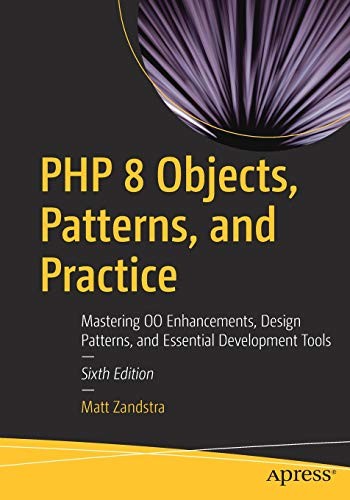
The only complete OOP + design patterns reference for PHP, updated for PHP 8.
Why this book
Zandstra names the disease in his introduction: the PHP developer who lives inside a framework ends up "regarding the innards of a framework as advanced magic", his own work reduced to "a minor adornment stuck up on top of a mighty unknowable infrastructure". He calls it being relegated to userland: waiting for remote gurus to fix bugs, never understanding the machine you live in.

The cure isn't to throw away Symfony or Laravel. It's to understand "the problems that frameworks solve and the strategies they use to solve them". That's the whole book, in three parts that give it its title: Objects (what PHP really does), Patterns (the strategies, in PHP and not in translated Java), Practice (the ecosystem around the code). Sixth edition, updated for PHP 8, written during three pandemic lockdowns at the corner of the kitchen table.
The ideas that stay
1Objects were an afterthought, and that explains a lot
"Many PHP projects start their life small and evolve into monsters" (p. 3). To understand why, Zandstra tells the language's story: objects were "once described as an afterthought by PHP's designers" (p. 13). The model was rebuilt version after version:
- PHP 4 silently copied objects on assignment: a generation of bugs without an error message;
- PHP 5 fixed the object model;
- PHP 7 typed it;
- PHP 8 polished it (promoted constructors, named arguments, attributes).
PHP 4's "generation of bugs without an error message" is concrete: assignment silently copied the object.
$account = new Account(100);
$copy    = $account;       // PHP 4: a COPY · PHP 5+: the SAME object
$copy->withdraw(50);
echo $account->balance;     // PHP 4: 100 (the bug!) · PHP 5+: 50
No error, no warning: just a wrong balance. Since PHP 5, an object variable holds a reference, not the object. Modern PHP is unrecognizable, and that's precisely why a book had to bridge the language's past and its present.
2"I had overprivileged inheritance": the confession that opens the patterns
The patterns section opens on a confession: "I found that I had overprivileged inheritance in my designs, trying to build too much functionality into my classes" (p. 254). His running example: a Lesson class with two axes of variation, the lesson type (lecture, seminar) and the pricing (fixed, hourly). Inheritance forces you to multiply the combinations; every new axis doubles the tree.
Composition takes a different route. The price computation moves out of Lesson and becomes classes in their own right, whose only job is to answer "how much?": price calculators, essentially. When a lesson is created, you hand it one of those calculators; when you ask the lesson for its price, it forwards the question:
// ✗ one subclass per combination: it doubles with every new axis
LectureFixed, LectureTimed, SeminarFixed, SeminarTimed…

// ✓ the book's design: the price gets classes of its own
class TimedCostStrategy {
    public function cost(Lesson $l): int { return $l->duration() * 5; }  // hourly
}
class FixedCostStrategy {
    public function cost(Lesson $l): int { return 30; }                // flat fee
}

class Lesson {
    public function __construct(private CostStrategy $price) {}
    public function cost(): int {
        return $this->price->cost($this);  // the lesson forwards the question
    }
}

$maths = new Lesson(new TimedCostStrategy());  // this one bills hourly
$piano = new Lesson(new FixedCostStrategy());  // this one, flat fee
Look at the last two lines: that's where it all happens. Two lessons of the same Lesson class, one billed hourly, the other flat, and no subclass was created. The pricing difference is no longer a difference of class: it's a difference of which object sits inside. And to change the pricing of an existing lesson (a last-minute promo), you hand it the other calculator: one line, zero hierarchy touched.
Hence the Gang of Four principle the book quotes: "encapsulate the concept that varies" (p. 269). Translation: in your problem, spot what changes from one case to the next (here, how the price is computed) and move it into classes of its own; what doesn't change (the lesson, its content, its length) stays where it is. Every new variant (a degressive rate, a member rate) becomes one more small class, instead of another row of combinations.
3Magic has hidden costs
PHP lets you intercept everything: __get, __set, __call catch access to properties and methods that don't exist. Frameworks feast on it. Zandstra's warning deserves to be framed: "Magic is arbitrary and unexpected. Magic bends the rules. Magic incurs hidden costs" (p. 136). An object full of magic methods lies to your editor, to static analysis, and to the next reader. Same vigilance for __clone: PHP copies objects shallowly, and a clone shares its object properties with the original until you clone them by hand.
4The four smells of a design gone wrong
Chapter 6 is the conceptual heart of the Objects part. Four signals that a design needs rework:
- Code duplication. The same routine scattered in several places: one change means hunting them all down.
- The class who knew too much. A class that peeks at globals and contexts beyond its own: it can't travel, can't be tested alone.
- The jack of all trades. A class that does everything: every new requirement makes it grow instead of growing the system.
- Repeated conditionals. The same
if/switchshowing up in several methods: that's a type hierarchy begging to exist. Polymorphism doesn't delete the conditional, it centralizes it in one place.
The most counterintuitive one, the last, in code:
// ✗ the same switch on the type, copied into every method
function fee($type)  { switch($type){ case 'std':...; case 'express':... } }
function eta($type)  { switch($type){ case 'std':...; case 'express':... } }

// ✓ one class per type: the switch is gone, adding a type = one class
class Standard { function fee(){...} function eta(){...} }
class Express { function fee(){...} function eta(){...} }5His contrarian stance: Service Locator first
The underlying debate: how does an object get its tools (the mailer, the database, the logger)? Two schools. Service Locator: the object asks a central registry that knows how to provide everything. Dependency injection: an outside assembler builds the object and hands it its tools ready-made; the object asks for nothing. Where most modern literature treats the latter as dogma, Zandstra weighs both like an engineer.
The Singleton? Dangerous if abused, but "I think that moderate use of the Singleton pattern can improve the design of a system" (p. 284), to be deployed "sparingly and with care". Full DI containers? "Dependency Injection offers purity, but it requires another kind of embedding. You must buy in to the magic of the assembler" (p. 329). His own choice: "I tend to prefer to start with the simplest solution and then to refactor to greater complexity, if needed. For that reason, I usually opt for Service Locator" (p. 329). You don't have to agree; a book that argues instead of reciting is worth more.
6The anatomy of Doctrine, rebuilt by hand
Chapter 13 builds, piece by piece, what every PHP ORM hides under the hood. Data Mapper: a class whose only job is to move data between objects and tables, "the great strength of this pattern is the strong decoupling it effects between the domain layer and the database" (p. 513). Identity Map: a registry that guarantees one object per database row, no double loading.
Unit of Work: the notebook that tracks what's new, dirty or deleted, and writes everything at the end. Lazy Load: the collection that only queries when accessed. Read this chapter, then open Doctrine's source: you'll recognize every organ by name.
7A mini-framework named woo, to prove there's no magic
Chapter 12 assembles the enterprise patterns into a small framework the book calls woo: a Front Controller that receives every request, commands that interpret it ("commands are a kind of relay station", p. 443), an Application Controller that picks the next view, a Domain Model that knows nothing about the database. It's a Symfony skeleton in miniature, built under your eyes.
Zandstra is honest about the price: this architecture "is not for the fainthearted. It does require a lot of up-front development before you begin to see benefits" (p. 449). That's exactly why frameworks exist: to pay that price once, for everyone.
8Development doesn't end with code
The third part is a statement: knowing how to design isn't enough, you need the ecosystem that makes delivery repeatable. "Development doesn't end with code" (ch. 14). The part walks through it:
- Composer and semantic versioning;
- Git for version control;
- PHPUnit and mocks for testing;
- coding standards (PSR-1, PSR-12, PSR-4);
- continuous integration.
One concrete piece of that vocabulary: semantic versioning (which you read in every composer.json) is not a random string of numbers, it is a message to whoever consumes your code.
"symfony/console": "^6.4.2"

   6  .  4  .  2
   │     │     └── PATCH : fixes a bug, nothing to fear
   │     └──────── MINOR : adds without breaking, safe
   └────────────── MAJOR : breaks the API, migrate by hand
The ^ says "accept MINOR and PATCH, never MAJOR": that is what makes a composer update safe. The tools chosen in 2021 have aged unevenly (Vagrant and Phing have lost to Docker and GitHub Actions, Jenkins survives in enterprises), but the claim itself has aged perfectly: a developer who masters objects and patterns yet can't test or version is only half a developer.
Three things I didn't know before reading it
- This sixth edition was written during three pandemic lockdowns, at "the corner of the kitchen table", with PHP itself evolving under the author's feet: code valid in early drafts was rendered incorrect by the language's fast evolution.
- For Git, Zandstra simply recommends reading Pro Git by Scott Chacon: the very book on the shelf of this library. The classics quote each other.
- Zandstra describes himself as "an inveterate reinventor of wheels", and turns the flaw into a method: the whole book reinvents (a framework, an ORM) precisely so you never mistake your tools for magic.
My take, honestly
This is the missing link of the PHP bookshelf. Plenty of books teach PHP, plenty teach patterns in Java; this is the one that does both at once, in the language you actually deploy. And Zandstra has a quality that's become rare: he weighs instead of preaching. His pages on Service Locator versus dependency injection say out loud what many seniors think quietly: purity has a cost, and the simplest thing that works is a legitimate starting point.
The reservations. It's 833 pages, and the prose is more workmanlike than thrilling: this is a reference you work through, not a page-turner. The Practice part has aged where it names tools (Vagrant, Phing, Jenkins): read it for the principles, substitute today's tools yourself. And PHP 8.0 is the ceiling: enums, readonly properties and fibers arrived just after.
In 2026, this book has a precise audience: the PHP developer who lives inside Laravel or Symfony and senses that the magic has to stop somewhere. Chapter 13 alone, read next to Doctrine's documentation, turns an ORM from a black box into a machine with named parts. And when AI generates your PHP, Zandstra's four smells are exactly the checklist for the code review.
Odilon
Still relevant in 2026?
The Objects and Patterns parts, fully: composition, the smells, the enterprise and database patterns are timeless, and PHP 8.0 syntax is today's syntax. The Practice part needs mental substitution: keep the principles (dependencies, tests, CI, standards), swap the tools (Docker for Vagrant, GitHub Actions for Phing and Jenkins). No newer edition exists; for what's missing (enums, readonly, fibers), the PHP release notes complete the picture.
Who is it for?
Read it if
- You write PHP daily inside a framework and want to understand what it does for you
- You've learned OOP basics and want the full bridge to patterns, in PHP and not in translated Java
- You use Doctrine or Eloquent and want to know what an ORM actually is
- You review AI-generated PHP: the four smells are a ready-made checklist
Skip it if
- You're learning PHP itself: this book assumes the language and teaches the design
- You want a Laravel or Symfony manual: it explains their anatomy, not their APIs
- 800 pages of reference is not your format: Head First Design Patterns covers the patterns part with more fun
For going further
The PHP OOP course on this site practices exactly this book's foundations, and the OOP course covers the design principles. In this library, Head First Design Patterns teaches the same patterns with ducks and pizzas, and Pro Git is the very book Zandstra recommends for version control. My article Learn PHP with Claude in 2026: master the language without becoming AI-dependent takes this further in practice.
Comments (0)