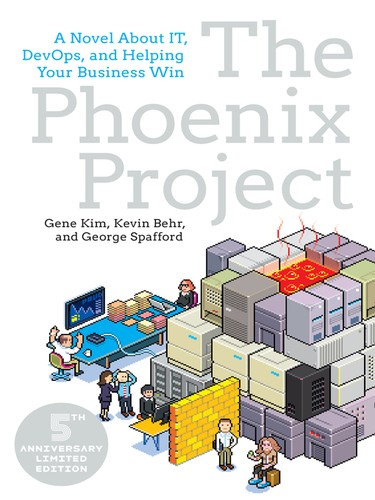
The novel that converted a generation to DevOps: a sinking IT project, and how to save it.
Why this book
It's a novel, the only one in this library so far. The hero is Bill Palmer. One Tuesday morning, his boss and his boss's boss get fired, and the CEO drafts him to run all of IT at Parts Unlimited, a struggling auto-parts company. That same day, payroll breaks: thousands of factory workers might not get paid. And that's just chapter 1.
Why tell this as fiction? Because the subject (how an IT team goes from constant chaos to smooth work, what we now call DevOps) is deadly boring as theory and gripping as a story. You live through the fires with Bill before understanding, at the same time he does, how to put them out for good.
The book converted a whole generation to these ideas: it sold by the hundreds of thousands and made "DevOps" a household word in tech.
The ideas that stay
1Your IT is a factory, and you can see it from above
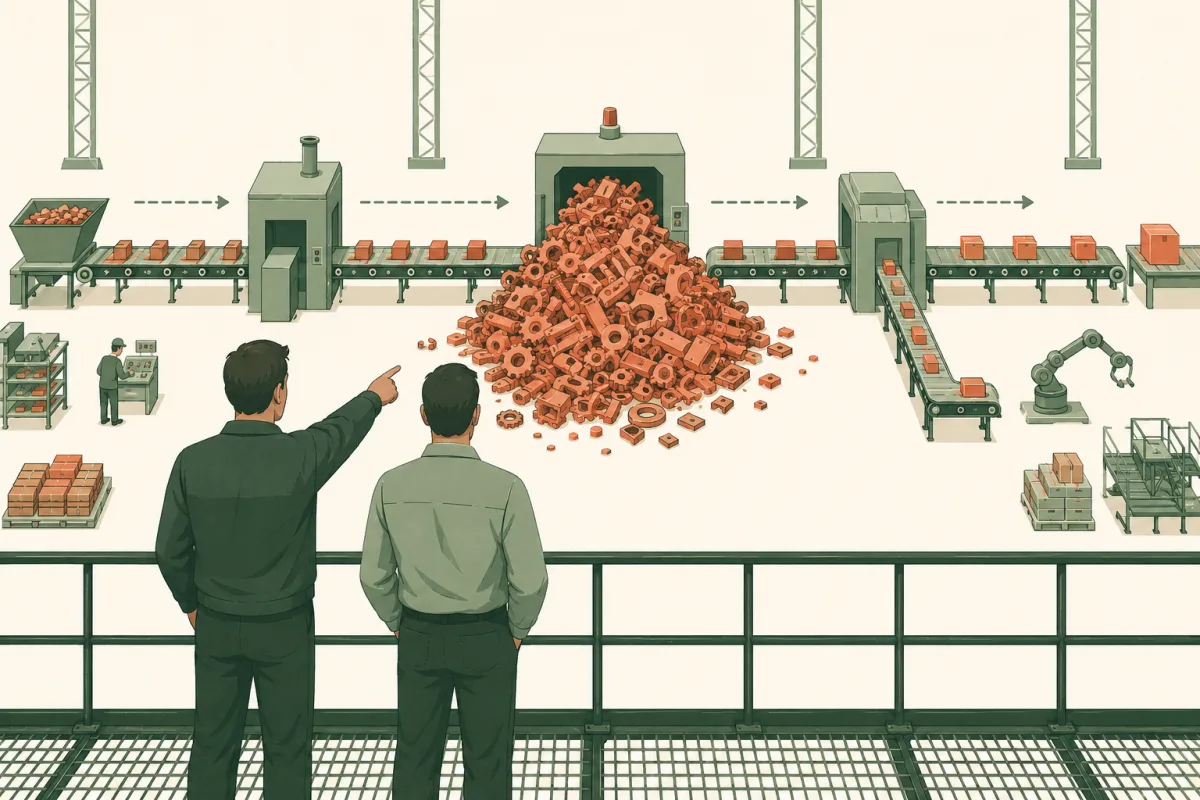
The book's founding scene: Erik, a mentor as brilliant as he is annoying, drags Bill onto the steel catwalk of one of the company's plants. From up there you see everything: raw materials coming in on the left, finished goods leaving on the right, and above all the places where things pile up. In front of a furnace, stacks of parts are waiting. Those stacks are work that's started but not finished, and Erik drops his first lesson: "WIP is the silent killer" (ch. 7). An IT team is the same: what matters is not being busy, it's making work FLOW all the way through. And just like in the plant, the traffic jams are invisible until you look from above.
2There are four types of work, and the fourth devours the other three
Erik refuses to hand Bill the list: he makes him discover it himself, chapter after chapter:
- Business projects (the famous Phoenix program);
- Internal IT projects (upgrades, migrations);
- Changes (everything you modify on the systems);
- Unplanned work, the final revelation, found in front of a planning board emptied out by emergencies: outages, firefighting, everything that was never on anyone's plan.
Erik even suggests calling that fourth one "anti-work" (ch. 15), because it doesn't move anything forward: it stops the other three from moving. The question that changes everything isn't "what are you working on?" but "where is your unplanned work coming from?".
3Brent, or why your best engineer is your biggest problem
Brent can fix anything. Every crisis goes through him, every project waits on him. He's the employee managers dream of, and he's exactly what's strangling the company: he is the bottleneck, the place where everything jams.
The novel shows him sitting at a keyboard, going "into a trance", fixing the issue in ten minutes… and answering "I have no idea. I just did it" when asked how (ch. 10). Bill coins the rule that sticks: "Every time that we let Brent fix something that none of us can replicate, Brent gets a little smarter, and the entire system gets dumber" (ch. 10).
Erik's corollary: any improvement made anywhere besides the bottleneck is an illusion. Hiring, speeding up, optimizing around Brent achieves nothing as long as Brent's knowledge stays in Brent's head.

4A calendar filled to 100% means exploding delays
The book's most counter-intuitive lesson fits in one division. The time a task waits in front of someone is their percentage of busy time divided by their percentage of free time (ch. 20). Someone busy 50% of the time: 50/50 = 1, the wait is short. At 90%: 90/10 = 9 times more waiting. At 99%: 99/1 = 99 times more. It's the Friday-evening highway: between 50% and 99% full, your travel time doesn't double, it's multiplied by a hundred. That's why "everyone is slammed" and "nothing moves" are the same sentence. Slack isn't waste: slack is what makes work flow.
5Fewer open projects means more finished projects
The novel's remedy sounds absurd: freeze every project except one for two weeks. Stop starting things in order to finally finish some. The result, measured by the head of project management in a memo to the CEO: in seven days of freeze, the team accomplished more than it usually gets done in a whole month (ch. 20).
The mechanism is the previous idea turned inside out: every open project loads the same people, and the more loaded they are, the more everything waits (wait time explodes between 90% and 99% utilization, see idea 4). Freezing nine projects out of ten drops everyone's utilization, and the one remaining project suddenly flows through the system with almost no waiting. Nobody worked faster; the queues were drained. Starting ten things moves nothing forward. Finishing one does.
6Shipping often is less scary than shipping rarely
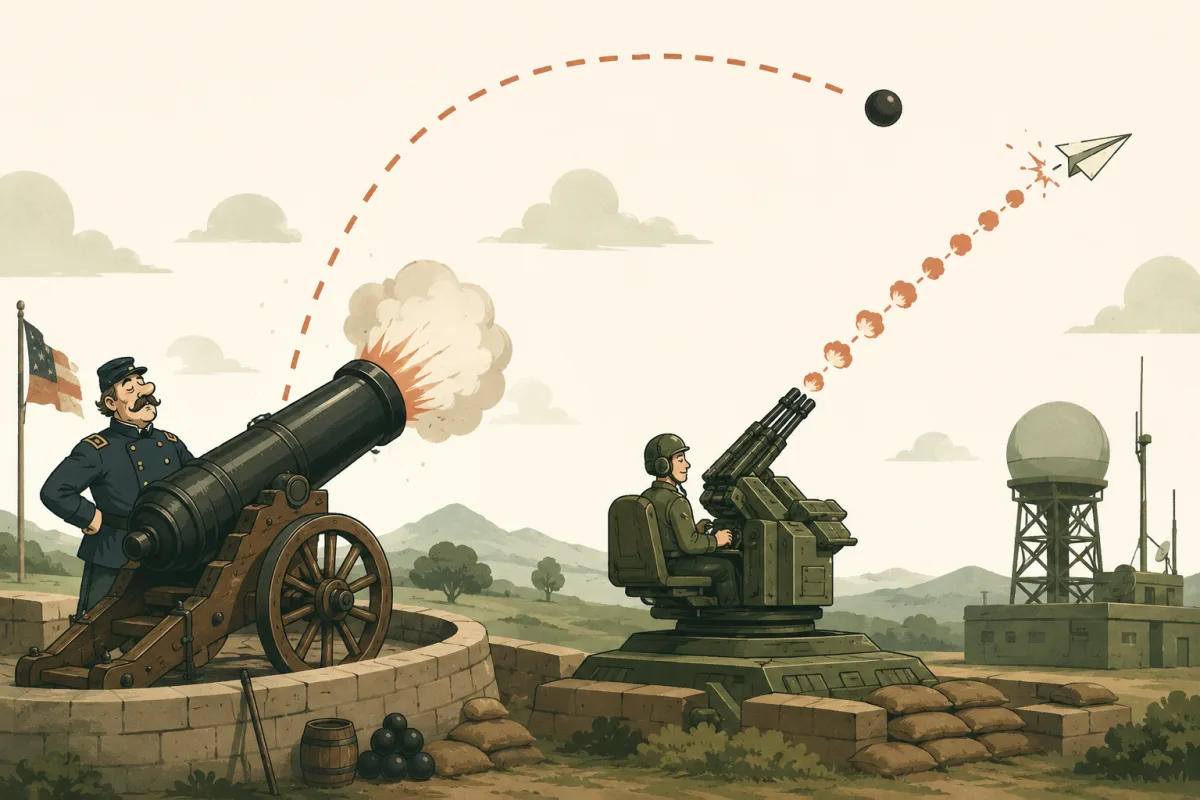
The big Phoenix deployment (the release prepared for months) turns into a disaster: all-nighter, stores down, credit card numbers leaking. Erik's diagnosis fits in one image: "Stop thinking about Civil War era cannons. Think antiaircraft guns" (ch. 29). One cannonball every nine months always misses a moving target; a continuous stream of small shots adjusts constantly.
So the team creates Unicorn, a small project allowed to break the rules, which cuts releases into small pieces and automates the code's whole journey to production. By the end of the book, deploying has become a daily non-event. The reference Erik cites is real: in 2009, two Flickr engineers showed they were deploying ten times a day, at a time when most teams treated a deployment as a quarterly event.
7Security that protects nothing is just extra work
John, the security chief, spends half the novel imposing controls everyone works around. Then he discovers, in an audit meeting, that his two-year crusade rested on a mistake: the financial checks further down the chain already caught the fraud he thought he alone was preventing. Breakdown, shaved head, and a rebirth: working WITH the flow instead of clogging it. Erik's lesson applies to every process gatekeeper, security, quality or compliance: you win when you protect the organization while keeping meaningless work out of the system (ch. 21).
8IT is not a department
The end of the novel zooms out. The CEO compares IT to electricity: not a service in a corner of the building, but a skill that runs through the whole company, "like being able to read or do math" (ch. 35). And he predicts: "In ten years, I'm certain every COO worth their salt will have come from IT". Written in 2013, that was a provocation. In 2026, it's almost an observation: companies that still treat IT as a cost center keep getting overtaken by those that made it their nervous system.
Three things I didn't know before reading it
- The founding moment the novel puts in Erik's mouth is a real event: John Allspaw and Paul Hammond's "10+ Deploys per Day" talk (Flickr) at Velocity 2009, widely considered DevOps' public birth certificate.
- The book ends on a mise en abyme: Erik commissions Bill to write a "DevOps Cookbook" to pass the method on, with this line: "Messiahs are good, but scripture is better." That book exists: Gene Kim later published it as The DevOps Handbook.
- The authors deliberately made the mentor annoying. Erik, the man with all the answers, insists on calling Wes (the operations director) "Chester", shows up late dressed like a delivery guy, and digs his granola bar out of a suitcase with a snorkel in it. The point: no solemn guru. Bill has to accept lessons from someone he'd rather not listen to, and so does the reader.
My take, honestly
This book pulls off what entire shelves of manuals fail at: getting flow-management ideas across to someone who has never opened a management book. The method is the story. You suffer three outages with Bill before Erik explains anything, and when the explanation lands, you needed it.
The concepts have faces: unplanned work is a board of cards emptied by emergencies; the bottleneck is Brent. Ten years after reading it, people still say "we have a Brent problem".
Let's be honest about the rest. As literature, it's an airport novel: characters as functions, a cartoonish villain (Sarah), a mentor with an answer for everything. The technical scenery has aged: it's all SANs and change advisory boards, no cloud, no containers. And the turnaround happens in four months, which is fairy-tale time: in real life, count in years.
But the paradox is delicious: if the scenery has aged, it's because the book won. Deploying ten times a day, unthinkable in 2013, is now routine. Reading The Phoenix Project in 2026 means understanding why today's tools exist.
And one thing hasn't aged a day: Brent. Every team has its Brent, the person everything depends on and whose knowledge never leaves their head. Generative AI doesn't change that, it even shifts the problem: the faster code gets produced, the tighter the bottleneck around the people who can validate and run it.
Odilon
Still relevant in 2026?
The principles, yes: types of work, bottleneck, work in progress, small batches, all timeless. The scenery, no: it's 2013 IT. For modern, concrete recipes, the sequel is The DevOps Handbook (the "cookbook" commissioned at the end of the novel); and The Unicorn Project (2019) tells the same story from the developers' side.
Who is it for?
Read it if
- Your releases are stressful events planned for nights or weekends
- Your team has a Brent: the person nothing ships without, and everyone depends on
- You want to understand what DevOps means without reading a manual
- You need to convince a non-technical boss: this book can be lent, a manual can't
Skip it if
- You want technical recipes: it's a novel; the commands and tools are in The DevOps Handbook
- You demand great literature: the characters are archetypes serving the ideas
- You work alone on small projects: the flow problems told here arise across teams
For going further
The Deployment course on this site practices exactly what the novel preaches: automated pipeline, small frequent releases, drama-free rollback. The Testing course covers the safety net that makes it all possible. Continuous Delivery is the engineering manual behind the novel: the concrete patterns Bill's team gropes toward. And the DDIA notes in this library explain what breaks on the systems side as you grow. For the order to read these books in, see my comparison of DevOps and engineering team books.
Comments (0)