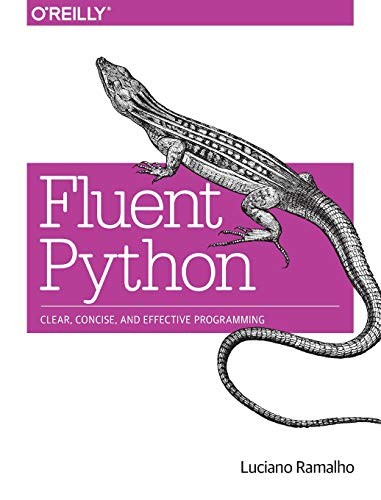
The book that turns a dev who writes Python into a dev who thinks in Python.
Why this book
There are dozens of books for learning Python. Fluent Python is not one of them: Ramalho assumes you already write Python, and tackles the next problem. Python that works but smells like translated Java, disguised PHP, copy-pasted JS. His angle: showing you how the language thinks, so your code speaks the same language as the interpreter.
The preface announces the method: use before you build. You use ABCs before writing one, you live with metaclasses before creating any. And a warning that sets the tone: "Premature abstraction is as bad as premature optimization" (preface).
The ideas that stay
1The iceberg: the Python Data Model
Why len(obj) and not obj.len()? Why does obj[key] trigger __getitem__? Because Python rests on a contract: the special methods (the "dunders": __len__, __getitem__...) that the interpreter calls for you. "The iceberg is called the Python Data Model, and it is the API that we use to make our own objects play well with the most idiomatic language features" (p. 3). Implement the right dunders, and your object works with len(), for, in, slicing — without inheritance, without declared interfaces.
And why isn't len() a method? Raymond Hettinger's answer, quoted in the book: for built-in types, CPython reads a C struct field directly, with no method call — no dispatch overhead. "Practicality beats purity." The whole book flows from that logic: the language favors consistent practicality over theoretical purity.
2Two methods, six capabilities for free
The opening example, FrenchDeck, is a 52-card deck in 15 lines. It implements only __len__ and __getitem__. Two methods, six capabilities for free:
len(deck)— sizedeck[0],deck[-1]— indexingdeck[12::13]— slicing (the four aces)for card in deck— iterationcard in deck— membership testsorted(deck, key=…)— sorting
No inheritance, no declared interface. That's the return on investment of the Data Model: implement the contract, the language does the rest.
class FrenchDeck:
    def __len__(self):
        return len(self._cards)
    def __getitem__(self, position):
        return self._cards[position]

>>> len(deck)        # 52
>>> deck[12::13]     # the four aces
>>> Card('Q', 'hearts') in deck   # True
3Variables are labels, not boxes
The most common Python trap comes from a wrong mental image. "The b = a statement does not copy the contents of box a into box b. It attaches the label b to the object that already has the label a" (p. 203). Hence chapter 6's HauntedBus: a mutable default parameter (def __init__(self, passengers=[])) is created once and shared by every instance built without arguments. Ghost passengers from one bus haunt all the buses created without passengers.
4Closures: the function carries its environment
A closure is a function that "carries with it" the variables of the place where it was born, even after that place is gone. The book's example, a running average:
def make_averager():
    series = []                       # local variable of make_averager…
    def averager(value):
        series.append(value)          # …yet averager still reaches it
        return sum(series) / len(series)
    return averager

avg = make_averager()
avg(10); avg(20)                      # 15.0 — series survived between calls
"A function that retains the bindings of the free variables that exist when it is defined" (p. 314). The trap the book takes apart: series.append(...) works (you mutate the list), but count += 1 would crash, because reassigning makes the variable local and hides the capture. The nonlocal count keyword exists exactly to say "no, keep the variable from above".
5Decorators and their two timelines
A decorator is target = decorate(target), nothing more: a function that wraps another to add behavior. The book's showcase, memoization in one line:
@functools.cache                 # one single line added above
def fibonacci(n):
    return n if n < 2 else fibonacci(n-1) + fibonacci(n-2)

# fibonacci(30): 832,040 calls → 31. 12 seconds → 0.0002 seconds.
Chapter 9 also installs a distinction that changes how you read code: the decorator runs at import (when Python reads the file), the decorated function only when called. That gap is what lets a decorator register a function in a table at load time, before it is ever called.
6Duck typing, goose typing: the Typing Map
Since Python 3.8 there are four ways to think about interfaces, mapped along two axes: runtime vs static checking, structural vs name-based typing:
- Duck typing — the object has the method, so it works. No declaration. A class with a single
__getitem__is iterable. Use for scripts and internal code. - Goose typing — ABCs +
isinstance. Explicit registration, runtime checks. Use when callers need a guarantee at runtime. - Static typing — Java-style type hints, checked by mypy/pyright. Use for large codebases and public APIs.
- Static duck typing —
typing.Protocol, Go's approach: structural matching checked statically, without inheritance. Use for public libraries that shouldn't force ABCs on callers.
The book's verdict: these four approaches are complementary, none deserves to be dismissed (p. 432). The map is there to help you choose deliberately — not to pick a camp.
7yield: the Iterator pattern built into the language
When data doesn't fit in memory, you need to produce items one at a time, on demand. Any function containing yield becomes a generator: it computes nothing until you ask for the next value.
def read_lines(path):
    with open(path) as f:
        for line in f:
            yield line.strip()       # one line at a time, never all in RAM

for line in read_lines('file_50gb.log'):    # works with a few KB of memory
    process(line)
A vocabulary precision the book hammers: a function returns a value and dies; a generator yields values and pauses between each, resuming exactly where it left off. Where Java codes the Iterator design pattern by hand, Python built it into the language with this one keyword.
8The GIL, explained in ten points
Chapter 19 defuses Python's most misunderstood topic: only one Python thread executes at a time, regardless of CPU cores. But every function that makes a syscall (disk I/O, network, time.sleep) releases the GIL. Consequence: Python threads are excellent at waiting ("Python threads are great at doing nothing", David Beazley, quoted p. 700) and useless for computation.
A lesser-known detail from point 6: many CPU-intensive NumPy/SciPy functions and the zlib/bz2 compressors also release the GIL, which is why threaded scientific computing can work. For CPU-intensive pure Python: multiple processes.

Three things I didn't know before reading it
- The entire asyncio documentation was re-tagged in under 12 hours after a single mailing-list post by Ramalho. Victor Stinner, Ben Darnell (Tornado) and Glyph Lefkowitz (Twisted) joined the thread, and the fix was live the same evening (Afterword, p. 959). His conclusion: the community is the best part of the ecosystem.
- "Python is a language for consenting adults" (Alan Runyan, quoted at the top of the Afterword): no real
private, nofinal. The language doesn't protect you from yourself, and that's a deliberate design choice. - The book is verifiable: every console session is a doctest.
python3 -m doctest example.pyreplays all the examples. 1,011 pages of code that actually runs.
My take, honestly
Its unique trick is the single thread. Other Python books pile up features; this one unrolls ONE idea (the Data Model) across five parts. And the examples have names: a FrenchDeck card game, a haunted bus. A haunted bus, in a technical book. Years later, you still remember it.
The deserved criticism: 1,011 pages. It's a marathon, and not everyone will finish. The type-hint chapters are dry, and Part V (metaprogramming) concerns maybe 5% of readers. Ramalho knows it: he built it as "five books in one". Treat it as a six-month bedside book, not a holiday read.
In 2026, AI generates Python that works, rarely Python that sings: useless getters, index-based loops where a comprehension would do, threading the GIL silently cancels. This book is the grid that lets you see the difference between Python and Java dressed up as Python.
Odilon
Still relevant in 2026?
Second edition from 2022, covering Python 3.10: pattern matching and modern typing are in. The optional-GIL project (PEP 703, Python 3.13+) doesn't change chapter 19's ten points yet: the GIL remains on by default. The fundamentals (Data Model, references, closures) don't move, because they are the language itself.
Who is it for?
Read it if
- You have 1-2 years of Python and your programs work without you always knowing why
- You come from Java, PHP or JS and your Python still looks like your old language
- You review AI-generated Python and want to spot what isn't idiomatic
- You want to understand the
__dunders__instead of copying them from Stack Overflow
Skip it if
- You're new to programming: Python Crash Course first, this one in two years
- You're looking for recipes to paste: this is a mental-model book, not a cookbook
- You use Python occasionally for scripts: the return on 1,011 pages won't be there
For going further
The fundamentals practiced in this book pair with the Python course on this site. For reviewing AI-generated code with a critical eye, see Coding with AI. The TypeScript equivalent of this book's role is Effective TypeScript, also in this library.
Comments (0)