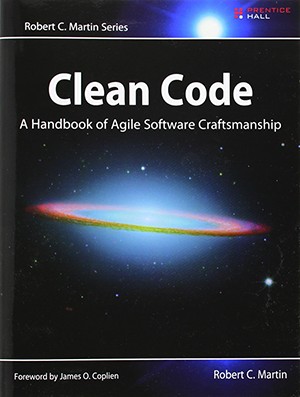
The book that taught a generation of developers that code is read ten times more often than it is written.
Why this book
Back when I was a programming instructor, I graded dozens of student projects. Variables named $a, 200-line functions, comments that lied about what the code below them actually did. And I couldn't really blame them: my own code from fifteen years ago looked exactly like that.
Clean Code is the book I wish someone had handed me when I started. Not because it reveals secrets, but because it puts words and rules on something we all end up feeling after years of maintaining code: readability isn't comfort, it's survival. I studied it closely enough to build a complete chapter-by-chapter synthesis, which I used with my students and eventually published on GitHub.
The ideas that stick
The book runs 464 pages across 17 chapters. Here is what actually stays with me, years later.
1Naming is design
The naming chapter alone is worth the price of the book. Its opening example: int d; // elapsed time in days. The comment is trying to rescue the name. Martin replaces it with elapsedTimeInDays and states his rule: "if a name requires a comment, then the name does not reveal its intent" (p. 18). It sounds trivial, but the deeper idea is this: if you can't find a clear name for a function, it's often because the function does too many things. The name is a design test in disguise.
2A function does one thing
Short, one level of abstraction, two or three arguments at most. One level of abstraction means the function names its steps without implementing them: shipOrder() calls checkStock(), computeTotal(), printLabel() — it does none of those things itself. Code should read top to bottom like a newspaper article: headline first, details after. It's the principle I apply most in my daily work, and the one I see least in the codebases I inherit.
3A comment is an admission of failure
Martin is radical on this, and the book's actual wording is harsher than its reputation: "Comments are always failures" (p. 54). His example, in code:
// ✗ the deodorant comment: it explains an obscure condition
// the employee has over 5 years of seniority AND is full-time
if (emp.seniority > 5 && emp.fullTime) { ... }

// ✓ extract a method that SAYS the same thing, and can't lie
if (emp.isEligibleForFullBenefits()) { ... }
The comment ages and lies within six months; the well-named method is checked by the compiler and stays true. The only legitimate comments explain the why, not the what:
- a business constraint that code alone can't express;
- a warning of consequences ("don't change this order — the payment processor requires it");
- a deliberate decision that would surprise a future reader.
Everything else ages badly, starts lying within six months, and nobody ever updates it.
4Errors are handled, not hidden
Exceptions instead of return codes, fail fast and loud instead of limping along in a corrupted state. Three rules the book makes non-negotiable:
- never an empty
catch—try { ... } catch (e) {}is a future bug with an unknown expiry date; - never return
null— you're creating null-checking work for every caller, and one missed check is enough for a crash; - never pass
nullas an argument — the callee can't tell if it's an oversight or an intentional value.
// ✗ the empty catch: the error vanishes, the bug stays (and the payment?)
try { payment.charge(amount) } catch (e) {}

// ✓ log it and let it bubble up: never swallow it silently
try { payment.charge(amount) }
catch (e) { logger.error(e); throw e }
5Don't talk to strangers
The Law of Demeter, and its vivid nickname: the "train wreck". A chain like $order->getCustomer()->getAddress()->getCity() couples your code to the internal structure of three different objects. The day one of them moves, everything breaks. Expose a method that says what you want, not the path to get there.
6Test code is real code
TDD (Test-Driven Development) means writing the test before the code. The chapter states its three laws:
- no production code without a failing test first;
- write just enough test to fail (compilation failure counts);
- write just enough code to make it pass.
A cycle "that is perhaps thirty seconds long" (p. 122), far shorter than most people imagine. And the point that stuck with me: Martin tells of a team that decided test code could stay dirty; the tests rotted, got thrown away, and defects soared. A messy test nobody dares touch eventually gets deleted, and the safety net goes with it.
7SOLID running through it all
Five principles, one acronym. The book doesn't present them as a catalogue; it brings them to life through examples:
- S — Single responsibility: a class has only one reason to change. A
UserServicethat handles both authentication and email sending has two — split them; - O — Open/closed: open for extension, closed for modification (add behaviour without touching existing code);
- L — Liskov substitution: a subclass must be usable wherever its parent is, without breaking anything;
- I — Interface segregation: better several small interfaces than one large one that forces classes to implement methods they don't need;
- D — Dependency inversion: depend on abstractions, not on concrete implementations.
The most useful one day to day, S, in code: a class should have only one reason to change.
// ✗ S violated: UserService changes if auth changes OR if email changes
class UserService {
  authenticate(login, pwd) { ... }
  sendWelcomeEmail(user) { ... }
}

// ✓ one class = one single reason to change
class Authenticator { authenticate(login, pwd) { ... } }
class Mailer        { sendWelcomeEmail(user) { ... } }
This is exactly the SRP dissected in the Clean Architecture note ("a module answers to one single chain of command"): here auth answers to the security team, email to the marketing team. Two bosses, two classes.
8The boy scout rule
"Leave the campground cleaner than you found it" (p. 14), adapted from Baden-Powell's farewell message to the Scouts. Probably the most famous line in the book, and the most applicable starting tomorrow morning: no big-bang refactoring needed, just a rename here, an extracted function there, every time you pass through a file. Technical debt recedes through small touches, not revolutions.

Three things I didn't know before rereading it
- The famous "code is read 10 times more than it is written" ratio comes from a concrete experiment: Martin played back his Emacs editing sessions like a high-speed movie. Most of the time: scrolling, reading, erasing, retyping (p. 13-14).
- The ultra-short-functions rule comes from a 1999 evening at Kent Beck's place, in front of a little program called "Sparkle" where every function was 2 to 4 lines. The program is lost: only Martin's memory of it remains (p. 34).
- The full TDD cycle (failing test, code, refactor) is "perhaps thirty seconds long" (p. 122). Not half a day: thirty seconds. It completely changes the mental image.
My take, honestly
The chapters on naming, functions and comments are timeless. Fifteen years on, I haven't read anything better on the subject, and it's what I had my students work on first.
But parts of the book have aged, and that needs saying. The examples are in Java, verbose, sometimes painful: the last three case-study chapters are 90 pages of listings nobody reads anymore (me included).
And Martin is dogmatic about the letter... while being more honest than his fans. He admits himself that no research backs the short-functions rule (p. 34), and that his own functions come out long and clumsy before being refined under tests (p. 49). In short, the "every function must be three lines" dogma comes more from his fans than from the book. Keep the core ideas: a function does one thing, a name should tell you everything. And don't take the numbers literally: three lines is a direction, not a rule to enforce in code review.
Odilon
Still relevant in 2026?
More than ever, for a reason nobody saw coming. The book opens with Martin's answer to those who predicted the end of programmers, code "generated instead of written". His 2008 answer still stands: specifying a need so exactly that a machine can execute it already is programming. In the era where AI writes a good share of the code, your job shifts from writing to reviewing, and judging generated code takes exactly the grid this book installs. Paradoxically, Clean Code is more useful today than when it came out.
Who is it for?
Read it if
- You've been coding for 1 to 5 years and nobody has ever seriously reviewed your code
- You maintain legacy code and want to understand why it hurts
- You review AI-generated code and want criteria to judge it
- You mentor juniors: it's a ready-made shared vocabulary
Skip it if
- You're looking for an architecture book: that's not the topic, see Clean Architecture instead
- Verbose Java makes you break out in hives: the second half will be rough
- You already practice SOLID, TDD and code review daily: you won't learn much
Going further
Several ideas from this book can be practiced directly in my free courses: splitting responsibilities in the OOP course, the red-green-refactor loop in the testing course, and the art of reviewing generated code in Coding with AI. For the order to read these books in, see my comparison of clean code and refactoring books.
Comments (0)