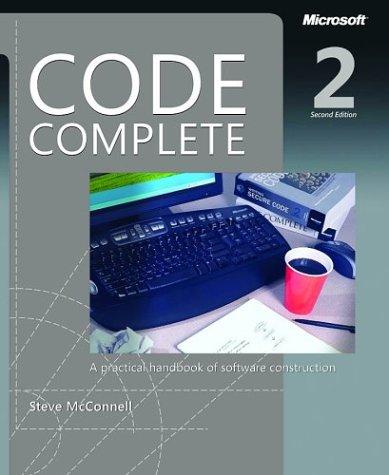
The practitioner's encyclopedia of software construction: evidence-based practices to tame complexity, proven across thousands of projects.
Why this book
Some programming books talk about technologies; others talk about the craft. Code Complete belongs to the second category, which is why it still sits at the top of every essential reading list twenty years later.
Steve McConnell had a declared goal: to narrow the gap between what researchers and professors knew and what practitioners actually did. The studies existed. The empirical results existed. But they were locked in academic journals nobody read. Code Complete did the translation work: 960 pages of data turned into advice you could apply the next morning.
The book doesn't cover a language, a framework, or a methodology. It covers software construction: the act of writing correct, readable, maintainable code. That's both its main strength and the source of its one real flaw. 960 pages is a lot, especially when some chapters treat Visual Basic 6 as a technology of the future.
The ideas that stick
1Construction is almost everything
McConnell uses "construction" in a precise sense: the set of activities tied to actually writing code. Debugging, unit testing, detailed design, integration. Not high-level architecture, not project management, not requirements gathering.
It's the only activity guaranteed to happen on every project. You can skip formal architecture. You can skip design meetings. You can't skip writing the code. And depending on project size, this phase takes between 30 and 80 percent of total effort (ch. 1).
Most books and training programs focus on architecture and process while leaving the moment of actually writing a function entirely unsupported. Code Complete fills that gap. When McConnell talks about "Software's Primary Technical Imperative," he's not talking about microservices or hexagonal architecture. He's talking about what happens line by line, routine by routine.
2Managing complexity is the whole game
Edsger Dijkstra — Dutch computer scientist and 1972 Turing Award winner — stated in 1989 that the complexity ratio between the smallest and largest programs a human mind can conceive is 1 to 10⁹. Today that ratio is closer to 1 to 10¹⁵. No human brain can hold a complete software system.
This is the central thesis of Code Complete, stated without hedging in chapter 5: "Managing complexity is the most important technical topic in software development." Everything else in the book follows. Advice on variable names, routine length, encapsulation — none of it has any justification other than reducing how much a developer must hold in working memory simultaneously.
Fred Brooks distinguished two kinds of difficulty. Accidental difficulties — cryptic compilers, batch programming, manual memory allocation — have mostly disappeared. Essential difficulties — the complexity of the real world you're trying to model in code — remain untouched. Those are what this book targets.

3ADTs: speak the language of the problem
Consider a module that manages font attributes in a text editor. The naive version:
// Turn on bold
$currentFont['attribute'] = $currentFont['attribute'] | 0x02;
The reader must know that 0x02 is the bold bit, that | is bitwise OR, and that attribute encodes multiple properties at once. They must reason at machine level.
The version using an ADT (Abstract Data Type — a structure that exposes operations, not its internal representation):
$currentFont->SetBoldOn();Same result, zero bits to understand. The code speaks the language of the problem. The internal representation can change — from an integer to a property array to a dedicated object — without touching a single line of calling code. Woodfield, Dunsmore and Shen (1981) measured the impact: developers working with ADT-organized code scored 30% higher on comprehension tests than those working with functional equivalents. As P. J. Plauger put it: "It ain't abstract if you have to look at the underlying implementation to understand what's going on." (ch. 6)
4One routine, one reason
McConnell presents a routine named HandleStuff(). It has 11 parameters, does nothing specific, reads and writes global variables, doesn't defend against division by zero, scatters magic numbers everywhere, and includes two parameters that are never used. He asks: "How many problems do you see?" Expected answer: 10. He listed 12 (ch. 7).
The primary reason to create a routine, in his view, isn't reuse. It's to reduce intellectual complexity: being able to call DeviceUnitsToPoints(x) instead of repeating the conversion formula everywhere. When the formula needs to change, you touch one place instead of the twelve where it was duplicated.
The empirical data is striking. A routine with functional cohesion (it does exactly one thing, and its name says so precisely) holds up far better over time. There's a second notion to add, coupling: how tightly a routine is hooked to others to do its job. The goal is high cohesion and low coupling.
A study by Selby and Basili (1991) of 450 routines measured it: the routines that combined the most coupling with the least cohesion had 7× more errors and were 20× more expensive to fix than those with the opposite profile. Not a style preference: a measured risk factor.
Names are a direct window into understanding. McConnell puts it plainly in chapter 11: "Temporary variables are a sign that the programmer does not yet fully understand the problem." A variable named temp or x in a quadratic equation solver isn't neutral — it's evidence that the developer hasn't yet committed to what the value represents. Rename it to discriminant and the algorithm becomes self-explanatory. The name carries the understanding.
5The barricade: where dirty data stops
Defensive programming is often misunderstood as "validate everything everywhere all the time." McConnell argues the opposite.
He proposes the barricade: a clear boundary in your code separating the outside world (unvalidated input, user data, API responses) from the inside world (business logic that can trust its arguments). Classes that validate dirty data live on the outside. Classes using clean data live on the inside.
An assertion (assert($value > 0)) documents an assumption that should never be false if the program is correct. It's not for handling user input — it's an internal safety net. Error handling is for normal-but-unexpected situations: a missing file, an API timeout. Andy Hunt and Dave Thomas (The Pragmatic Programmer) put it directly: "A dead program normally does a lot less damage than a crippled one." (ch. 8)
In Symfony, the barricade is the controller. Raw data (the HTTP request) enters a DTO that carries the validation rules, the Validator component checks it, and any error is handled right there (a 422 response). Past that line, the domain service receives an already-validated object and no longer has to distrust anything.
// DIRTY SIDE: the controller takes the raw request and validates it.
final class OrderController {
    public function create(Request $req, ValidatorInterface $validator): Response {
        $dto = CreateOrderDto::from($req);              // raw data
        $errors = $validator->validate($dto);           // the barricade
        if (count($errors) > 0) {
            return new JsonResponse((string) $errors, 422);   // error handled HERE
        }
        $this->service->place($dto);                    // past this point, everything is clean
        return new JsonResponse(status: 201);
    }
}

// CLEAN SIDE: the domain service trusts its arguments.
final class OrderService {
    public function place(CreateOrderDto $dto): void {
        assert($dto->quantity > 0);   // internal net, NOT input validation
        $order = new Order($dto->email, $dto->quantity);
        // ... business logic, period. No re-validation.
    }
}
The assert() on the clean side is not input validation (the Validator already did that): it is the chapter's internal safety net, disabled in production, saying "if we reach this point with a negative quantity, that's a bug on our side, not bad user input".
6Quality reduces costs
This is the most important idea in the book for any technical lead. McConnell calls it "the General Principle of Software Quality": improving quality reduces development costs. Not just maintenance costs. Total costs.
A concrete anchor for this principle: the cost of fixing a defect multiplies by a factor of 10 to 100 depending on when it's found. A requirements error caught during the requirements phase costs one unit. Caught during system testing: 10 units. Caught post-release: 10 to 100 units (Fagan 1976; Boehm and Turner 2004). McConnell calls this "the most important fact of software engineering."
Debugging and rework already absorb about 50% of typical project time — not because it's inevitable, but because most defects are found at the wrong stage. The math is simple: shift detection upstream.
The evidence: no single defect-detection technique exceeds 75% efficiency (modal). Unit tests catch about 30% of defects. Formal code inspections catch around 60%.
A formal inspection is a structured, prepared review with defined roles (a moderator, a reader, reviewers) and a checklist, whose sole goal is to find defects, not fix them on the spot. It's code review pushed to its most rigorous, far from a quick glance at a pull request. Reaching 90%+ requires combining multiple techniques.
The cost difference is striking. IBM measured (Kaplan 1995) that one hour of code inspection cost 3.5 hours per defect found. One hour of testing cost 15 to 25 hours per defect. A separate IBM study found each inspection hour prevented roughly 100 hours of downstream work — tests, fixes, customer escalations (Holland 1999). Capers Jones analyzed thousands of projects: every one that achieved over 99% defect-removal efficiency had used formal code inspections.
This doesn't mean dropping tests. McConnell's metaphor from chapter 22 is hard to top: "If you want to lose weight, don't buy a new scale; change your diet. If you want to improve your software, don't just test more; develop better."
7Humility as a technical skill
Edsger Dijkstra's 1972 Turing Award lecture was titled "The Humble Programmer." His thesis: the best developers know their brain is too small. Ego is the main obstacle.
McConnell picks this up in chapter 33 and states it plainly: "The people who are best at programming are the people who realize how small their brains are."
This isn't zen advice. It's a direct consequence of software complexity. A developer who believes they can hold everything in their head doesn't document, doesn't test, doesn't listen in code reviews. They accumulate technical debt with the conviction that it's under control.
McConnell tells the story of the worst developer he ever encountered: variables named x, xx, xxx, xx1, xx2 — all global, zero comments. Her manager thought she was brilliant because she fixed bugs fast. The bugs she had introduced.
Practical humility means:
- admitting you don't understand a compiler warning rather than ignoring it
- giving realistic estimates rather than pleasing ones
- treating code reviews as help rather than criticism
McCue (1978) measured that programming is 85% communication with humans and only 15% communication with a computer (ch. 33).
8Program into your language, not in it
McConnell's concluding chapter draws a sharp distinction. Programming in a language means staying within whatever the language natively provides. No enumerated types in the language? Use vague numeric constants. No assertions? Skip them. Follow the path of least resistance.
Programming into a language means deciding first what you need to make the code readable and correct, then figuring out how to implement it in the language at hand. If there's no built-in assertion mechanism, write your own assert() function. If the language lacks strongly typed domain values, create wrapper classes.
The same principle extends to methodologies. McConnell dedicates a full section (§34.9) to what he calls "religion in software development" — dogmatic adherence to a single design method, a commenting style, the absolute avoidance of global data. His conclusion is unambiguous: "Whatever the case, it's always inappropriate." What replaces dogma is the intellectual toolbox: each technique is a tool, not a revealed truth. The good developer knows which one to reach for, and doesn't try to do everything with a hammer because they've decided hammers are superior to screwdrivers.
9Debug with a method, not with instinct
Chapter 23 of Code Complete is entirely about debugging — which takes up roughly 50% of a typical project's development time. Most developers treat it as intuition, treasure hunting, brute-force trial and error. McConnell argues there is a systematic approach that the best debuggers follow, and the gap between good and mediocre is measurable.
A 1975 study by John Gould had nine programmers debug identical programs: the three best found all their bugs in 5 minutes on average and introduced 3.0 new defects in the process. The three worst took 14 minutes and introduced 7.7 new defects — meaning they were making the code actively worse while "fixing" it.
The method:
- stabilize the bug (make it reproducible every time)
- formulate a hypothesis about its cause
- test the hypothesis with the minimum change needed to confirm it
- fix it
- look for similar bugs elsewhere
McConnell's insistence on hypothesis before action is key: "Finding the defect — and understanding it — is usually 90 percent of the work." Most developers skip to action and spend 90% of their time guessing.
McConnell introduces the concept of psychological set: we see what we expect to see. He shows the classic "Paris in the the Spring" sign — most people miss the duplicate "the" — and ties it directly to code. A developer who named two variables SYSTSTS and SYSSTSTS used both for months without noticing they were different. Good names, consistent spacing, and careful formatting are not stylistic preferences: they reduce the cognitive effect that causes debugging blindness (ch. 23).
The practical tip that works immediately: when stuck, explain the bug out loud to someone. This is what McConnell calls confessional debugging. The book's example: a developer starts explaining a mysterious problem to Jennifer; mid-sentence, he finds it himself. Jennifer didn't say a word. "This result is typical," McConnell notes. The act of reconstructing the causal chain for another person forces the mental shift from "searching" to "understanding."

My honest take
Code Complete is the book I wish I had read early on. Not all 960 pages — the first hundred would have been enough. The thesis on complexity, ADTs, cohesive routines, defensive programming: these are lessons most developers learn by getting burned on real projects, after humiliating code reviews, after maintaining code they can't understand. The book short-circuits that painful curriculum.
What has aged is real and visible. Code examples are in C++, Java, and Visual Basic 6. The code-tuning chapters talk about CPU cycles and processor pipelines — this is archaeology, and it's labeled as such in the table of contents. The programming tools chapter (30) reads like a museum catalog.
What holds is everything about humans: the inspection economics, the debugging psychology, professional humility, complexity as a universal enemy. These parts haven't moved an inch. If anything, they're more relevant in 2026 than in 2004 — codebases are larger, teams more distributed, technical debt easier to accumulate.
Read Parts I, II, and VII, plus chapters 20 and 21. That's roughly 250 pages. Enough to walk away with the important ideas. The rest is reference material: useful in specific moments, soporific in linear reading.
Odilon
For whom?
Read it if
- You're starting out and want to move from "it works" to "it reads and maintains"
- You have practice from experience but have never seen the empirical data behind it
- You run code reviews and need solid arguments to convince the team
- You feel "quality" and "speed" are always in tension
Skip it if
- You're looking for a language or framework guide
- You need 2026 code examples for low-level sections
- You've already read Clean Code and WELC — you've covered the essentials
Go deeper
The construction ideas in this book connect directly to practice in two courses: the refactoring concepts of chapter 24 in the Testing course, and the defensive programming ideas in the Web Security course. For the DDD extension of "programming into your problem domain," see the DDD Reference fiche. For the order to read these books in, see my comparison of clean code and refactoring books.
Comments (0)