Table of contents (11 sections)
Pico CSS is archived, and its author says why: AI writes the CSS in its place.
Pico is a CSS framework, a ready-made stylesheet (buttons, tables, forms) that you plug into a page so it looks presentable. Pico's is tiny. It styles HTML without classes: no class attribute to add on every element. I recommended it in a 2024 article.
Its code is published on GitHub, in a repository that is now archived: nothing changes in it anymore. The last push dates from October 4, 2026. The author explains it in the README, the repository's front page. According to him, AI can now produce a light, accessible page with just the CSS it needs. A framework therefore matters less than before.
If the author is right, picking a CSS framework for a new site no longer makes much sense. If it is false, there is still a reason to do it. A claim like that can be tested. I had Claude generate 48 pages, with or without a framework. I ranked them without knowing which page used which framework.
What the archive README says
Here is its reason, translated: "Today, AI can generate lightweight, self-contained, accessible HTML with just the CSS it needs." The rest, which I also translate: a minimal CSS framework for semantic HTML "matters less than before". To stay relevant, Pico would have to be rewritten from scratch. The author judges that this would be "a different project". "Accessible" means usable by everyone, including by keyboard or with a screen reader.
Nothing breaks, though: Pico's files stay downloadable and anyone can take over the code. The latest version is 2.1.1, released on March 15, 2025.
The author's sentence promises a lightweight, accessible page. It implies a third criterion, which everyone judges first: the page should be pleasant to look at. I turned all three into measurements:
- Lightweight: the gzip size, meaning compressed the way it travels over the network
- Accessible: the serious defects found by axe-core, an automated tool
- Pleasant: a blind ranking, by me and by a judge model
I also record the price of each page: the model bills it by the number of tokens, the chunks of text it writes. That leaves the pages to build and measure.
The test: 48 pages, compared in blocks of four
The idea fits in one sentence. I ask three models for the same page, with or without a framework, then rank the results without knowing who did what. Four things vary:
| What changes | The values |
|---|---|
| The framework (the "condition") | No framework, Pico, Simple.css, Oat |
| The model | Claude Haiku 5.5, Sonnet 5.5, Opus 5.5 |
| The page type | A showcase page, an admin page |
| The repetition | Two identical tries |
That makes 4 × 3 × 2 × 2 = 48 pages. Pico 2.1.1 is the framework in question. Simple.css 2.3.7 does the same thing, HTML without classes. Oat 1.1.0 is a recent framework, released on November 1, 2026. With no framework, the model writes all the CSS itself.
Both pages describe a fictional company. The showcase page has offers, an article, a comparison table and a form. The admin page has alerts, toggles, a dense table of 8 users and a long form. Every section has a mandatory id.
The model returns two files, index.html and style.css, with no JavaScript, no inline style and no external resource. For the three frameworks, the framework's CSS file and its official documentation are copied into the working folder.
To compare like with like, I group the pages in blocks of four: same model, same page type, same repetition. Within a block, only the framework changes. That makes 3 × 2 × 2 = 12 blocks.
Each page gets a random identifier and the mapping table stays hidden. I rank each block from 1 (the best page) to 4, without knowing which page uses which framework, and before seeing any measurement.
A second judge, the Fable 5.2 model, ranks the same screenshots. It goes through each block twice, in different orders, to limit the effect of display order, and it may tie two pages. I do not merge our two opinions: I give both.
One rule is set in advance. I want a clear gap, not chance. A condition beats another only if it wins at least 10 blocks out of 12, the other then winning 2 or fewer. Winning a block means ranking ahead of the other in that block, and a tie takes the block out of the count. Both judges must reach the threshold. Otherwise, I write "no difference shown".
With no framework, the model does at least as well as Pico
Both judges put "no framework" and Oat first, then Pico, then Simple.css. Simple.css loses to "no framework" in all 12 blocks, with both judges.
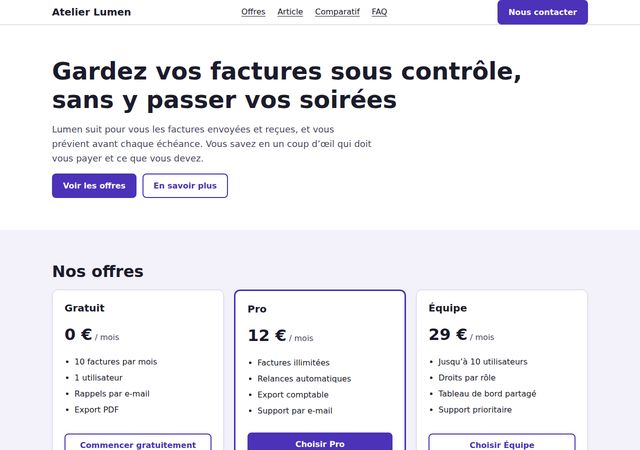

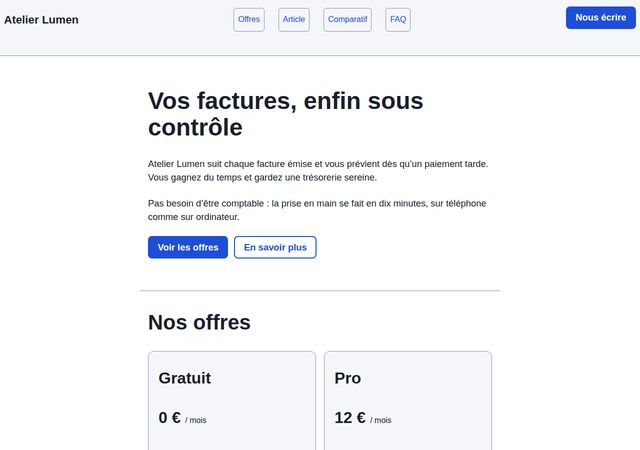
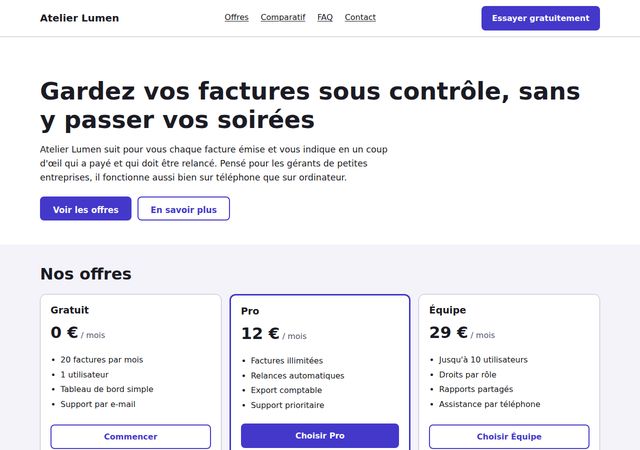
On Pico, our opinions diverge. Fable favors "no framework" in all 12 blocks. I do so in only 7 against 5, which is not enough: the rule asks for 10. So I conclude "no difference demonstrated", and I do not average the two of us.
Oat equals "no framework", without beating it
Oat is the only framework that stays level with "no framework". It beats Simple.css in 10 blocks out of 12 for me and in 11 for Fable. Against Pico, it wins 9 blocks for me, under the threshold, and 11 for Fable. Between Oat and "no framework", neither reaches 10. The second wins 5 blocks out of 12 for me, 5 out of 11 for Fable. No difference shown.
That level has a price. Its CSS weighs 11.4 kB gzipped. With Sonnet, it is $0.17 at the median (the middle value over the 4 pages) with Oat, against $0.10 with no framework. Oat costs more with all three models. Its pages are also the only ones with these three measured defects:
- 2 pages out of 12 with insufficient color contrast (a serious axe-core defect)
- 1 page with horizontal overflow at 320 px wide
- 4 elements on 2 pages with no visible marker when navigating with the Tab key
So Oat catches up with "no framework" on looks. It still costs more and piles up defects that "no framework" does not have.
Same ranking of the frameworks, very different prices
With each of the three models, the frameworks rank in the same order. For me, Simple.css is last with each of them. For Fable, "no framework" and Oat are ahead of Pico with each of them. Four blocks per model prove nothing on their own, but no model contradicts these two points.
The models differ mostly on price. Here is the median cost of a page, in dollars:
| Cost of a page | No framework | Pico | Simple.css | Oat |
|---|---|---|---|---|
| Haiku | 0.02 | 0.02 | 0.03 | 0.03 |
| Sonnet | 0.10 | 0.10 | 0.11 | 0.17 |
| Opus | 0.55 | 0.31 | 0.69 | 0.85 |
A page with no framework costs $0.02 with Haiku and $0.55 with Opus. The choice of model therefore weighs far more on the bill than the choice of framework.
Does Opus make nicer pages?
The first test compares the frameworks with each other: in each block, the model is the same. So it says nothing about the models. It takes another ranking.
I group the 48 pages by three: one Haiku page, one Sonnet page, one Opus page, with the same framework and the same instruction. That makes 16 groups. I rank them blind, and so does Fable.
The rule is fixed in advance. A model beats another if it wins 7 of the 8 groups of the first repetition, a threshold close to 10 out of 12. The other 8 groups, the second repetition, serve as a check: I verify that the result repeats.
Haiku has the worst average rank with both judges. On Opus, our opinions diverge. Fable puts Opus ahead of Sonnet in 14 groups out of 16. I do so in only 9, and in 6 of the 8 groups of the rule: that is below the 7 required, so no difference demonstrated.
So Fable clearly sees a better rendering with Opus: if we believe it, the extra cost has something in return. I do not take it for granted. My ranking is a quick visual judgment, without an accessibility check. And Fable is a Claude model, like Opus: I cannot rule out that it favors it.
The price, on the other hand, is certain: with no framework, an Opus page costs more than 5 times a Sonnet page. The gain in looks, on the other hand, stays uncertain: only one of the two judges sees it.
The verdict, criterion by criterion
Let's go back to the three criteria in the author's sentence:
- Lightweight: no, Pico adds 11.7 kB to save 0.4 to 1.9 kB.
- Accessible: "no framework" ahead of Pico (3 pages with a scrollable area unreachable by keyboard) and ahead of Oat (three kinds of defects).
- Pleasant: "no framework" and Oat ahead, Pico and Simple.css behind.
My take
The author is right about a minimal framework like Pico. What it offered, a decent page with no effort, the model does alone. On these 48 pages, no framework beats "no framework" in a demonstrated way.
I do not conclude that all frameworks are dead. Oat shows that a recent framework can match the model alone. But a framework is no longer the way to get a decent page. It has to bring what the model cannot guess. For example the same design from one page to the next, or a vocabulary a whole team shares. I tested neither of these two uses: that is my bet.
Another bet, which this test does not measure: I would start from Sonnet, with a human glance at each round to improve the page. With no framework, the price of one Opus page pays for about five Sonnet rounds. The other option: Opus for the first version, then Sonnet.
What this test does not say
Five limits:
- 12 blocks, 2 page types, a fictional company. I doubt that another type of page would change the meaning of the result, but I did not test it.
- A single human judge, me, and Fable is a model looking at screenshots.
- Oat offers JavaScript, which the instruction forbade: I tested it without.
- Results valid for Haiku, Sonnet and Opus 5.5 and Fable 5.2, in November 2026: other versions may rank differently.
- Nothing on maintenance: a generated page is not a page kept up for three years.
Conclusion
We used to pick a framework so as not to start from a blank page. With Sonnet, a blank page now generates for $0.10. Across these 48 pages, it ranks level with the best of the three frameworks tested. A minimal framework like Pico therefore no longer has a reason to exist. For the others, I do not know: I tested neither Bootstrap, nor Tailwind, nor a component framework.
What a framework still has left is what the model cannot guess: my choices, repeated identically from page to page.
For a backend-leaning dev like me, for whom CSS has always been a punishment, AI is a blessing.
Sources
Documentation consulted on November 26, 2026:
- Pico CSS README, with the archive message
- Pico CSS 2.1.1, the latest version
- Simple.css 2.3.7, the version tested
- Oat 1.1.0, the version tested
- axe-core, the accessibility checking engine
- Pico, classless version, the mode used